
Lagos does not announce itself quietly. It arrives as noise and motion: okada engines threading through gridlock on the Third Mainland Bridge, the low hum of a thousand generators filling the gaps left by an unreliable power supply, new fintech offices rising beside markets that have operated on cash and instinct for decades. One part of the city can look like a laboratory for the future; another can feel as though it has been waiting decades for the infrastructure to catch up. Depending on the hour, Lagos can either be the most exhausting city in Africa or the most alive.
That contradiction is Nigeria in miniature. This is a country that has exported Afrobeats from Lagos to London, New York and Los Angeles. It has built Nollywood into one of the world's largest film industries by output. It is home to Flutterwave and Paystack, companies that convinced Silicon Valley and Stripe that African fintech was not a niche but a category. Its writers, designers, academics and professionals have carried Nigerian influence into almost every major city in the world.
Beneath all of that is sheer scale. Nigeria has roughly 242 million people, more than every country in Europe, and a median age still in its teens, a demographic engine most nations would trade their entire economy for. For decades, it has carried the nickname "Giant of Africa," and worn it without irony.
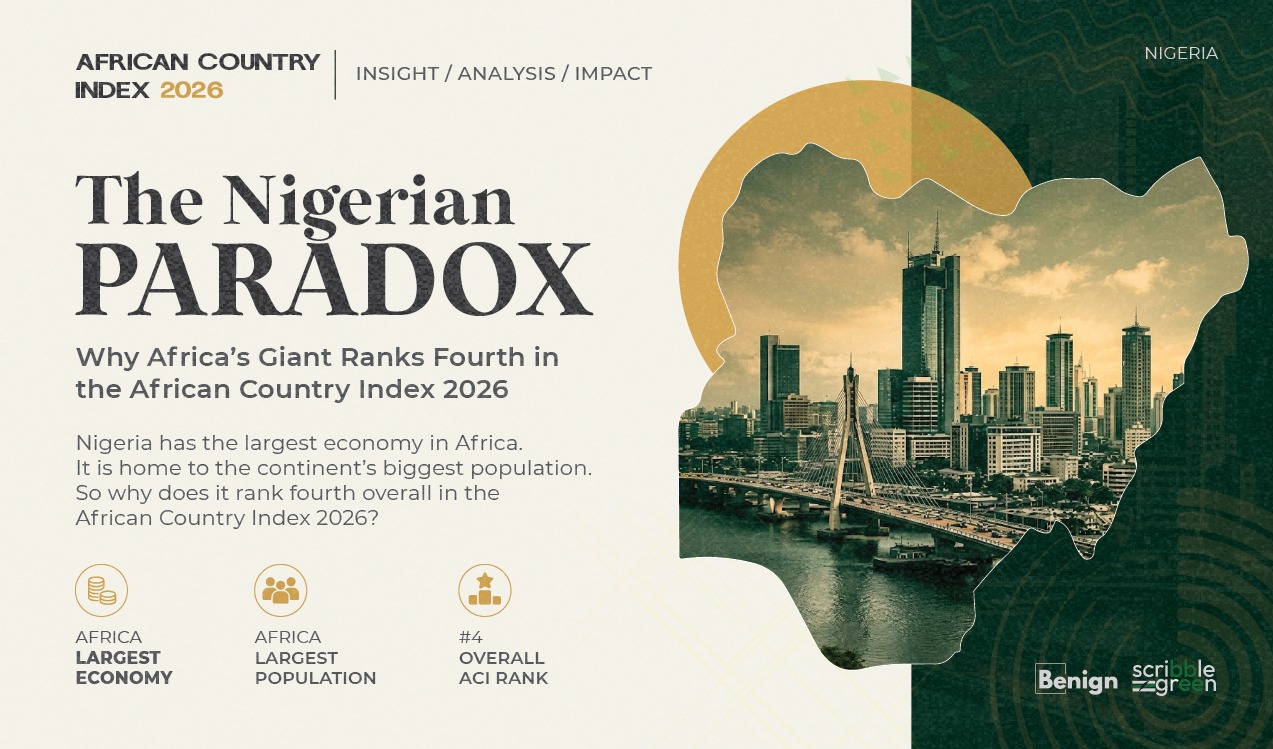
So here is the question: if Nigeria has the population, the economic weight, the cultural influence and the entrepreneurial energy that investors associate with continental leadership, why does it rank only fourth among Africa's 54 countries?
I have sat in enough rooms, in Lagos and outside it, where this question gets asked and answered badly, usually with a single word: currency, or corruption, or infrastructure, delivered with total confidence and almost no evidence behind it. I wanted a better answer than that. Over the past several months, working with the team at Benign, I built one: the African Country Index 2026, a research project scoring all 54 African markets across five dimensions of economic and commercial performance, not just the ones that make headlines.
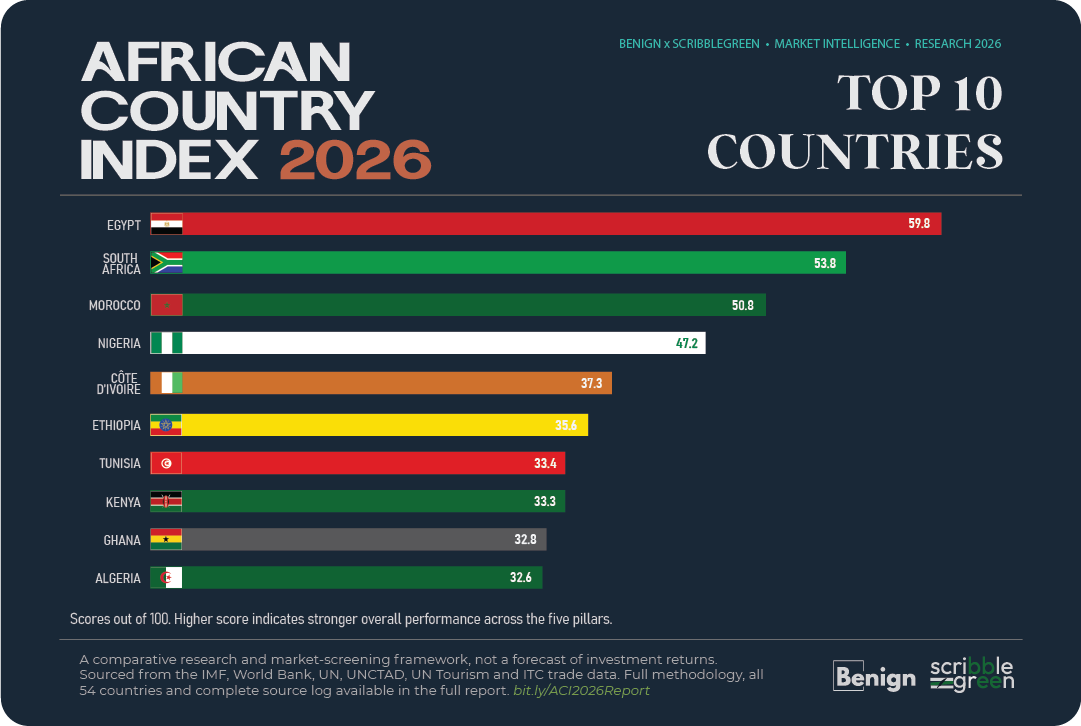
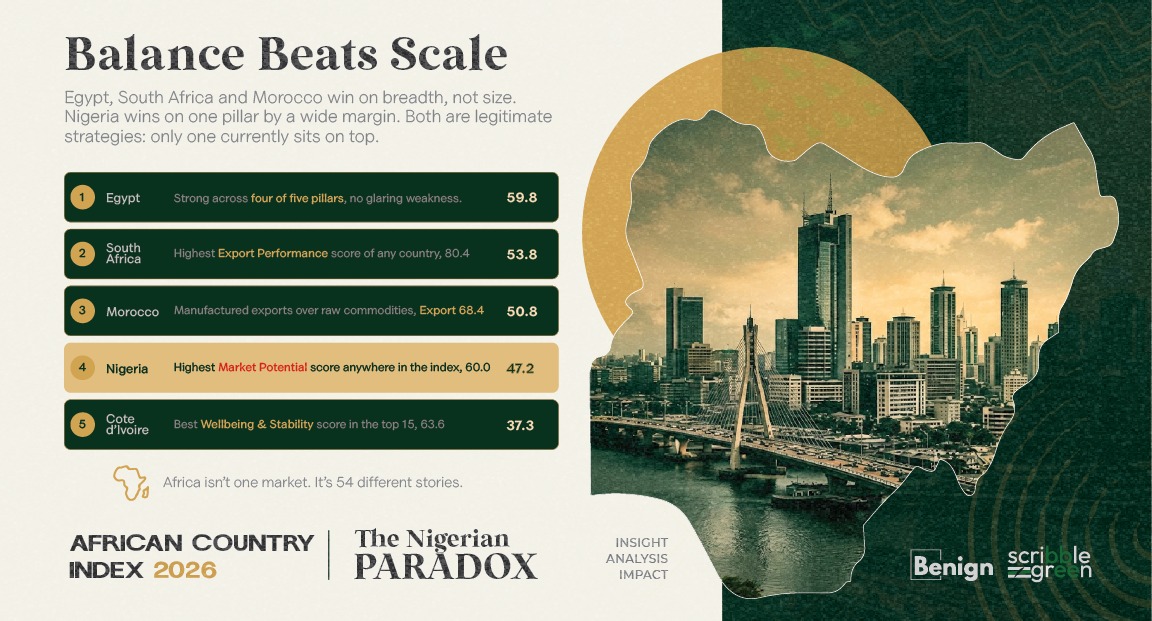
Run Nigeria through it, and the country lands fourth, behind Egypt, South Africa and Morocco, three economies each smaller than Nigeria's in at least one obvious respect. That gap, between what Nigeria's size implies and where it actually sits, is not a flaw in the measurement. It is the most useful thing the measurement produces, because it forces a more honest question than "who's biggest." It asks what "biggest" is actually good for.
Why This Needed a Proper Index
Most conversations about African markets still run on a handful of headline numbers: GDP, population, growth rate, maybe a natural resource or two. Those figures are not wrong; they are just incomplete. A number tells you the size. It does not tell you whether the currency you'll be paid in will hold its value, whether the country's exports depend on one commodity or twenty, whether global capital already trusts the place enough to show up in volume, or whether the population everyone cites as "opportunity" can actually be reached and served profitably today.
The African Country Index was built to close that gap. It scores every market across five pillars: Economic Strength, which is the closest thing to the traditional GDP-and-growth story; Economic Wellbeing and Stability, which covers currency risk, debt, and how easy a country actually is to operate in; Export Performance, which looks at what a country sells to the world and how exposed that makes it; Global Reputation and International Connectivity, which measures how connected a country is to capital, institutions, and culture beyond its borders; and Market Potential, which captures population and demographic scale, the pure size-of-opportunity number everyone starts with and far too many stop at.
Each of those five pillars is itself built from a stack of specific indicators, more than twenty in total, from credit ratings to AfCFTA trade integration to how concentrated a country's export base is in a single product. The point of building it this way was simple: a country can be excellent on one dimension and merely adequate on the rest, and a single ranking number will hide that completely unless you're willing to take it apart.
Take it apart for Nigeria, and the paradox stops being a mystery.
The Case Nigeria Should Be Winning
Nigeria has almost everything that makes a market look irresistible on paper.
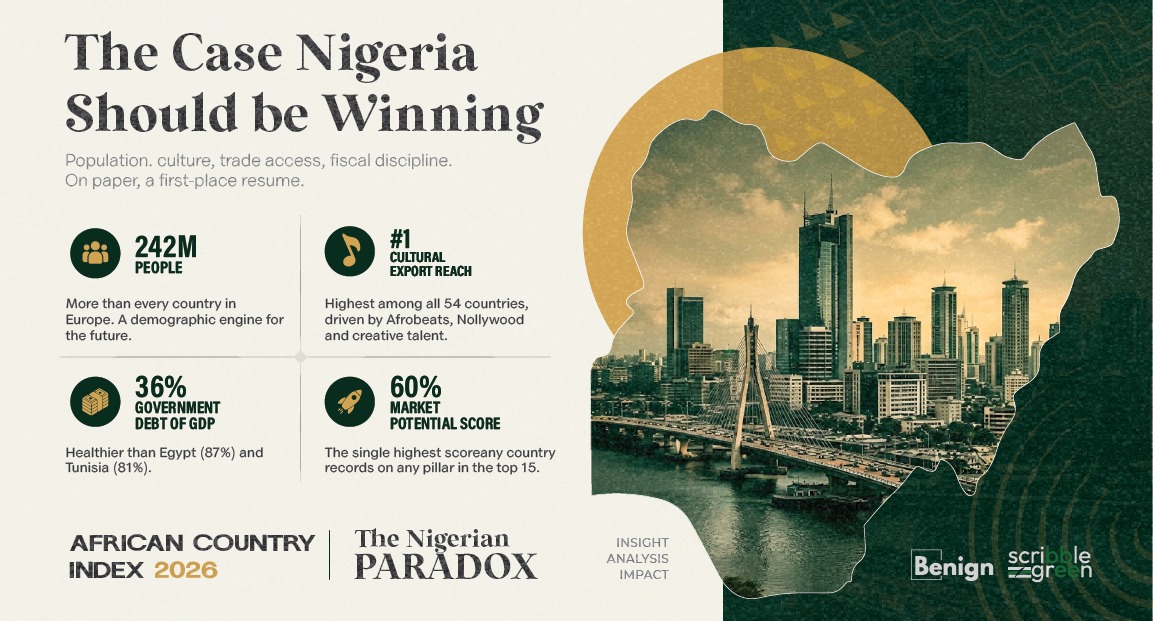
Start with scale. With more than 242 million people, Nigeria has Africa's largest population and one of its most consequential consumer markets. That scale is not simply a statistic. It means a deeper pool of consumers, workers, and entrepreneurs, as well as future demand. The ACI captures this directly: Nigeria scores 60.0 out of 100 on Market Potential, the highest score recorded by any country on any pillar in the top 15.
Then there is cultural reach. Nigeria's influence travels far beyond its borders. Afrobeats has become a global cultural export, while Nollywood has built one of the world's largest film industries by volume. In the ACI's Global Reputation & International Connectivity pillar, Nigeria's Cultural Export Reach score is 95 out of 100, the highest among the 54 countries assessed. The number puts a data point behind something that is already difficult to miss.
Nigeria also has an unusually strong entrepreneurial engine. From fintech companies such as Flutterwave and Paystack to a broader creative and technology ecosystem, Nigerians have repeatedly demonstrated their ability to build businesses around market gaps. That matters because market potential is only useful when businesses can convert demand into economic activity.
There is also trade access. Nigeria has ratified the African Continental Free Trade Area and completed its tariff concession schedule, placing it in the deepest AfCFTA implementation tier tracked by the ACI. For a company thinking beyond Nigeria's domestic market, this creates a potentially important platform for regional expansion.
And then there is a quieter advantage: government debt. Nigeria's government debt stands at about 36 per cent of GDP, considerably below Egypt's 87 per cent and Tunisia's 81 per cent in the index's data. Debt alone does not tell us whether a government is fiscally well managed, but the relatively low debt burden does give Nigeria some room that more heavily indebted economies may not have.
Put those pieces together and the case becomes compelling. A huge population. Extraordinary cultural reach. Entrepreneurial depth. Regional trade access. Significant natural resources. And a comparatively low government debt burden. The problem is that Nigeria’s strengths are concentrated. The country's exceptional market potential sits alongside weaker performance in other areas that matter when an investor moves from looking at a market to actually operating in one.
Where the Story Changes
Why does Egypt sit ahead of a country with half its population and, by some measures, a comparable economy? Not because Egypt is bigger. It isn't, not in the way that matters most to the "Giant of Africa" story. Egypt wins because it is strong almost everywhere at once. Its Export Performance score of 61.6 beats Nigeria's by a wide margin, built on a far more diversified base than oil alone. Its Reputation and Connectivity score, 76.7, is nearly double Nigeria's, reflecting Egypt's 2024 accession to BRICS, its long-standing role as a bridge between Africa, the Middle East and Europe, and a single 2024 investment deal that alone pushed its foreign direct investment past 46 billion dollars, more than forty times what Nigeria attracted that same year. Egypt is not winning on one overwhelming strength. It is winning by having no glaring weakness, in a competition where Nigeria has a very specific and visible one.
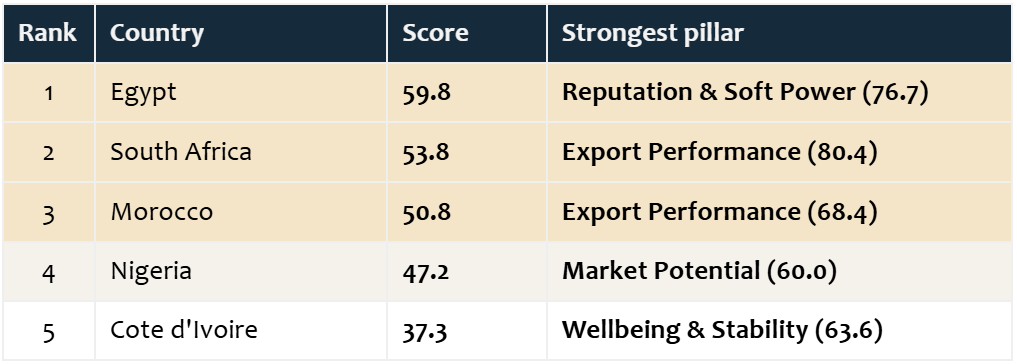
South Africa, in second place, wins a different way: the highest Export Performance score of any country in the index, 80.4, the product of the continent's most diversified, complex economy and its deepest capital markets. What keeps South Africa from first is almost the mirror image of Nigeria's problem, a Market Potential score of just 16.2, reflecting a population a quarter the size of Nigeria's, and a Wellbeing and Stability score that is actually lower than Nigeria's own.
Morocco, in third, tells a smaller, tighter version of the same story. Its population is a sixth of Nigeria's, and its Market Potential score of 9.6 reflects that. But Morocco's export base leans on manufactured goods, cars, wiring harnesses, aerospace components, not raw commodities, and that shows up too: a diversification and stability profile that beats Nigeria's on nearly every dimension except size.
And what does Nigeria do better than either of them? On Market Potential, it is not close: Nigeria's 60 dwarfs South Africa's 16.2 and Morocco's 9.6 combined. Less obviously, Nigeria's Wellbeing and Stability score of 45.9 is actually stronger than South Africa's 25, a detail that quietly contradicts the instinct to assume Nigeria is the more fragile of the two economies. Nigeria's fiscal position, with a 36 per cent debt-to-GDP ratio, is healthier than either country's. The Giant of Africa is not fragile everywhere. It is exceptional in exactly one place and merely solid almost everywhere else, and that combination is precisely what a composite score is built to expose.
The Four Pillars Where Nigeria Is Solid, Not Special
Four scores clustered in the mid-40s, and one that stands alone at 60. That pattern is the entire Nigerian paradox in a single row of numbers, and each of those four numbers has a real story behind it, not just a statistical footnote.
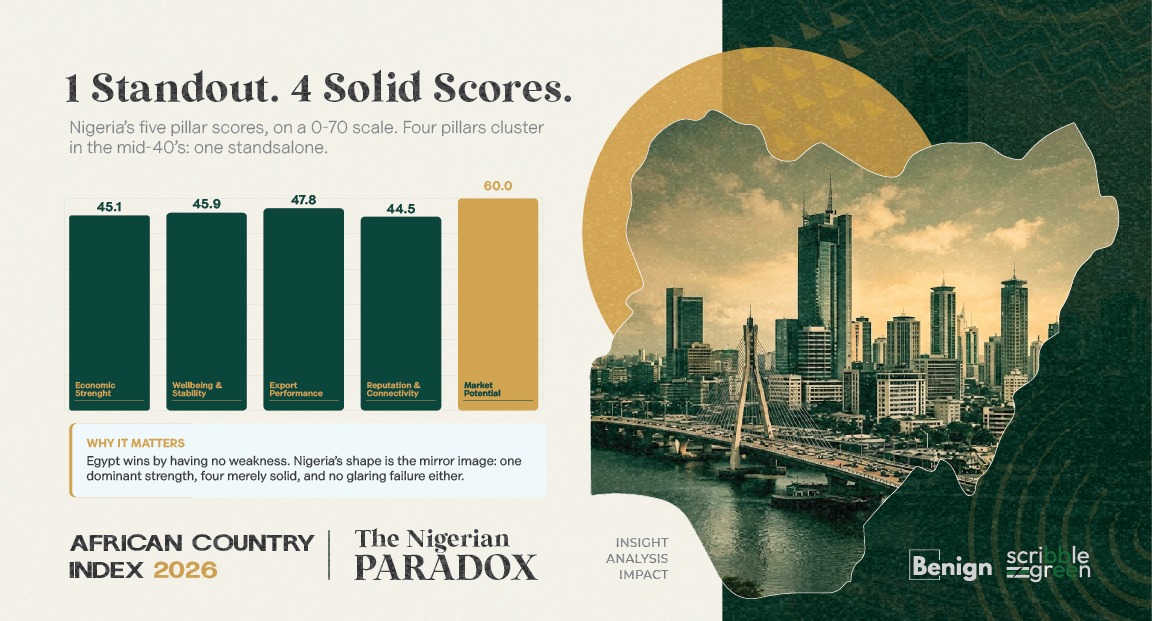
Economic Strength sits at 45.1 because a large GDP, divided among 242 million people, yields a per-capita income far lower than the topline figure suggests. Size and prosperity are not the same measurement, and Nigeria's economy, for all its scale, has not yet translated that scale into income per person the way Algeria's or Botswana's has.
Economic Wellbeing and Stability sits at 45.9, largely due to the naira. Nigeria floated its currency in 2023, and the depreciation that followed was steep and well documented, the kind of move that erodes local-currency revenue overnight and turns every repatriation plan into a guessing game. Compare that to Côte d'Ivoire, which anchors its currency to a fixed peg and scores 63.6 on the same pillar, and the price of monetary flexibility becomes very easy to see.
Export Performance, at 47.8, carries the sharpest warning in the entire dataset. Crude oil accounts for roughly 75 per cent of everything Nigeria sells to the world, one of the most concentrated export bases of any economy the index measures, trailing only Angola. Exports contracted over the most recent year on record. By the index's estimate, barely 3 per cent of what Nigeria exports is processed or manufactured rather than pulled from the ground and shipped out raw. A GDP figure will never show you that kind of concentration. An export breakdown will.
Global Reputation and Connectivity, at 44.5, holds the most counterintuitive numbers in the whole exercise. The pillar weighs sovereign credit, foreign investment, institutional standing, cultural reach, tourism, diaspora ties and academic presence together, and on the capital side of that ledger, Nigeria is thin: just 1.08 billion dollars in foreign direct investment in 2024, against Egypt's 46.6 billion, and its sovereign credit rating sits in the lower half of the range this index tracks. The country has built a cultural reputation that reaches every corner of the globe. It has not yet built a capital-markets reputation to match it, and until it does, that gap will keep showing up in the numbers.
A Balance Story, Not a Weakness Story
It would be easy, reading all of this, to conclude that Nigeria is a risky bet. But that is not what the data says, and it is not what fourth place out of 54 countries means.
Reweight the index toward growth and demographic scale, the priorities a very different kind of investor might hold, and Nigeria climbs to second place, ahead of Morocco. Across every scenario the index tests, Nigeria's rank never falls below fourth. That is not the profile of a weak economy. It is the profile of an economy whose position depends heavily on what you are optimising for, which is a fundamentally different thing, and arguably a healthier one to be told by your data.
Egypt wins on balance. Nigeria's position is the mirror image: dominant on one dimension, solid but unremarkable on the rest, with a small number of sharp, specific, and well-documented risks that sit alongside its scale. Read that way, the ranking stops being a scoreboard. It becomes a set of investment archetypes: Egypt for balance, South Africa for diversified industrial depth, Morocco for manufacturing access, Nigeria for scale and growth, carried alongside real structural exposure.
What This Means If You Are Actually Trying to Do Business Here
Nigeria is not a market to avoid. It is a market to enter with your eyes open to exactly which risks you are choosing to underwrite.
If your thesis rests on consumer scale, digital adoption, or reaching the largest addressable population on the continent, the data supports you without qualification. That advantage is real and it is durable. If your thesis depends on currency stability, a diversified supply chain, or an easy regulatory and foreign-exchange environment, the same data says you need a hedge, a longer time horizon, or an entry structure built differently than the one you would use in Morocco or Côte d'Ivoire.
That, and not a leaderboard position, is the actual use of a tool like this. Not "where does Nigeria rank," but "which specific risks am I choosing to hold, and did I choose them on purpose, or did I simply not know they were there."
What the Index Is Actually For
The Nigerian paradox is not an anomaly the African Country Index happened to turn up. It is the reason the project exists.
Africa is constantly discussed in terms of a handful of headline numbers: GDP, population, growth rate, FDI, and natural resources. Every one of those numbers is real and useful. None of them, alone, tells an investor what they actually need to know, which is not "how big is this economy" but "what combination of scale, stability, trade exposure, global connectivity and demographic runway am I actually buying into, and what am I giving up to get it." A company weighing Nigeria against Kenya, or Morocco against Egypt, is not choosing between four GDP figures. It is choosing among four different combinations of opportunity and risk. Until now there has not been a serious, structured way to lay that choice out clearly, market by market, across the whole continent.
That is what the Benign team and I set out to build: not a scoreboard, but a way to ask a sharper question about any one of 54 countries at once. What is the opportunity? How ready is the market to receive it? How much confidence does the underlying data actually support? What is the specific downside? And what does an entry strategy look like once those first four questions have been answered honestly?
Nigeria's answer to that question looks nothing like Egypt's. Morocco looks different again. A single rank was never going to tell you that. The research underneath it can, and that is the entire point of building it in the first place.
The African Country Index 2026 is an independent, 54-market research project developed by BATi and the team at Benign. It is a comparative screening tool, not a forecast of investment returns, and not a substitute for country-, sector-, or transaction-level due diligence. The full report, including the complete methodology, the underlying data, and the rankings for all 54 markets, is available to download here: bit.ly/ACI2026Report.