The Beginning
I started designing around the age of ten, perhaps even earlier. Before designing, I drew. I had big dreams for my artwork. I always wanted my paintings to outlive me. I was fascinated by Leonardo da Vinci and the way his work has endured and continues to speak long after his lifetime.
But, somewhere along the way, my dreams changed. I found myself falling in love with clothing design.
I cannot say exactly when the idea of designing clothes became part of me, but I know who influenced my love for it. She laid the foundation, and I simply took it and made it my own.
My big sister, Stephanie.
Oh, how I love Stephanie.
She taught me so much of what I know. I took what I learned from her and slowly tweaked it until it became something that felt like me.
My mother was also one of my greatest supporters. She knew how passionate I was about art and design, so she enrolled me in a summer art school. And boy, did that change something in me. I sharpened my skills, explored my creativity, and became even more certain that art was a language I understood.
After graduating from high school, I stopped seeing the need to pursue art—or perhaps, I stopped seeing the need to pursue the version of myself I had imagined.
Until sometime in my second year of university, I experienced a deep desire to change.
It was not because there was anything inherently wrong with who I was. I felt, in my spirit, that it was time to evolve. The Holy Spirit seemed to be reminding me that I could become the person I had always wanted to be.
Classy. Elegant. Intentional.
As time passed, I found myself drawn particularly to Art Deco, Old Hollywood glamour, and the elegance of another era.
I began to realise that I was an old soul. I have always been drawn to things from another time. I have always had a particular fondness for my great-grandmother and her old songs, black-and-white films, classical literature, and the beauty of things that seem to carry a story.
Eventually, I knew I wanted my designs to carry those feelings too.
And that contributed to the birth of Theos Elegance.
The Becoming
I have always loved jazz.
I got that from my dad.
Whenever my dad picked me up from art school, he would play old-school jazz and funk in the car to brighten my day. It became one of those little things that I carried with me.
My love for that music also connects me to family and memories that are deeply meaningful to me. My uncle, who introduced much of that musical influence into our family, is no longer here, but jazz allows me to hold on to a small piece of his memories.
Since then, jazz and old-school funk have become part of my everyday life.
They are almost a daily dose for me; a day rarely passes by that I don’t vibe to jazz.
Jazz always made me wonder what life was like in the early to mid-1900s.
How did people behave?
How did they speak?
How did they walk?
What did they wear?
What did they consider beautiful?
That curiosity eventually led me to old Hollywood films.
One of my favourite films is Sabrina (1954). I loved its combination of fashion, music, romance, and elegance, and I was especially captivated by Audrey Hepburn's effortless presence. I loved its combination of fashion, music, romance, and elegance, and I was especially captivated by Audrey Hepburn's effortless presence. There was something about the way she embodied grace. It did not feel forced. It felt natural. That quality has stayed with me.
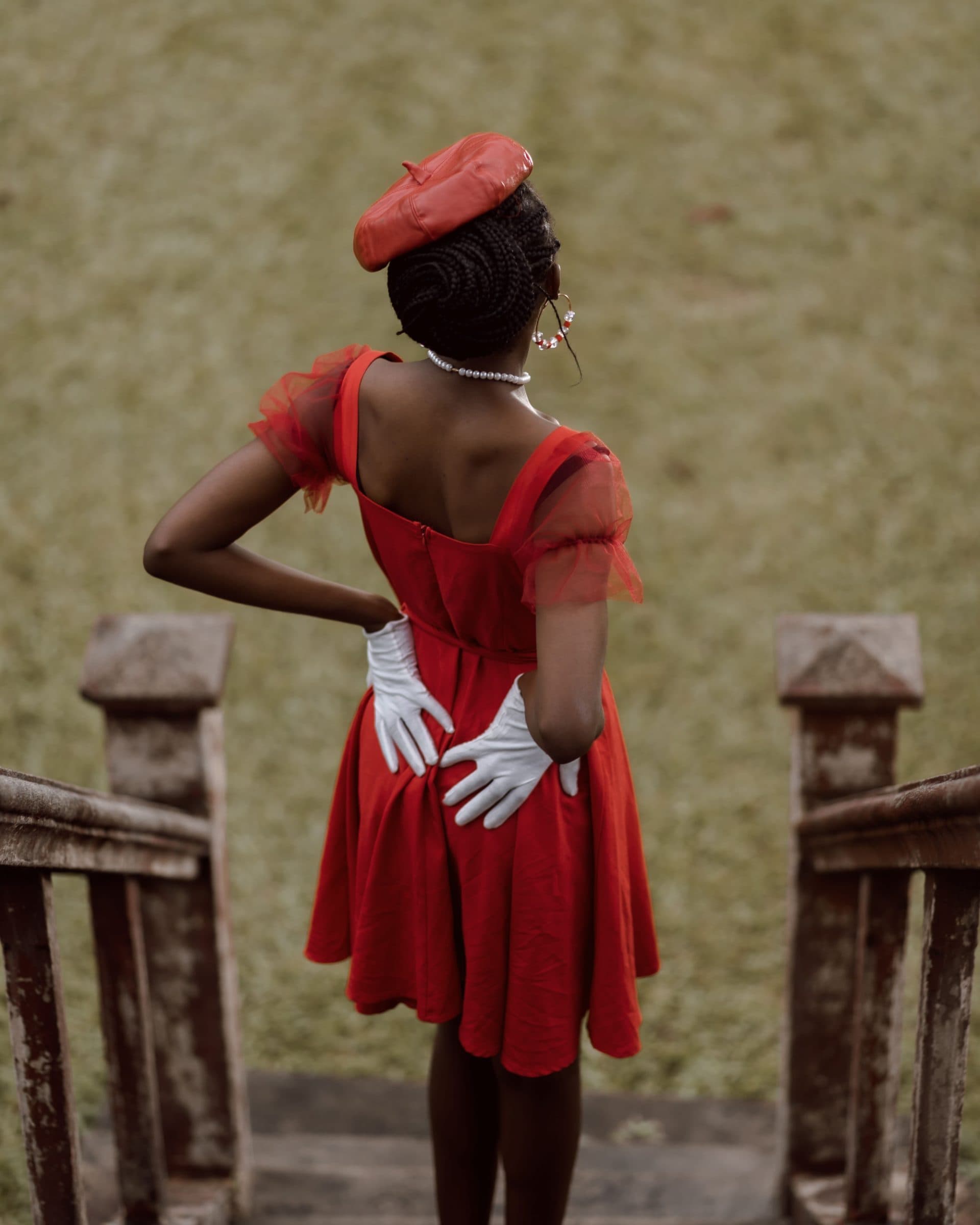
This piece was originally meant to be my dress for my twentieth birthday.
I would call her “The Betty.”
The name came from Betty Boop, a character I remembered and loved. To me, the dress represents entering adulthood with class and grace. I wanted it to mark a transition—not simply from being nineteen to twenty, but from one chapter of my life into another.
I made sure she was heavily embellished because, to me, embellishment represented something more than decoration. It represented good fortune. I wanted the dress to carry a little wish for the years ahead: that adulthood would be beautiful, meaningful, prosperous, and ever attractive.
The design itself was inspired by the Art Deco movement of the 1920s, an artistic era known for geometric forms, sleek lines, symmetry, luxurious materials, and an appreciation for glamour.
I imagined “The Betty” with a sleek, linear silhouette, geometric embellishments, and an overall sense of luxury—something reminiscent of Old Hollywood.
Old Hollywood has become a significant part of my design language because of the way women of that era dressed with intention. Clothing felt connected to occasion, presentation, and personal style. There was an awareness of how a woman entered a room and how she chose to be seen.
That idea has also influenced the way I dress myself.
For me, fashion is not simply about putting clothes on the body.
It is about identity.
It is about memory.
It is about the person you are becoming.
And sometimes, it is about looking at the girl you once were and realising that, somehow, she was already becoming the woman you are today.
More than anything, I am inspired by “The Betty”.
She represents the kind of woman I imagined myself becoming.
A woman who loves jazz.
A woman who carries herself with grace.
A woman who creates attention without desperately seeking it.
A woman who is soulful, intentional, and clear about where she is going.
A woman who moves with purpose and knows how to restrict distractions.
The early twentieth century fascinated me because of its relationship with jazz, fashion, literature, and changing ideas of womanhood. I wanted to capture some of that atmosphere in the piece, not simply by recreating the past, but by taking what spoke to me and making it part of my own language.
So, in many ways, “The Betty” is not simply a dress.
She is a self-portrait.
She is my childhood creativity, my sister's influence, my mother's encouragement, my love for art, my fascination with history, my love for jazz, my faith, my imagination, and my transition into adulthood—all stitched together into one piece.
The Betty is a piece of my journey into womanhood.
And perhaps that is what I love most about design. You can make something beautiful out of everything that makes you who you are.
When I think about “The Beginning,” I realise that this dress was never really about ending childhood or simply turning twenty. It was about beginning again. It was about taking the girl who loved to draw, the girl who listened to jazz in her father's car, the girl who admired old films and dreamed about the past, and allowing all of her to become part of the woman I was growing into.
In that sense, “The Betty” is not the end of a chapter. She is the beginning of one.
The Betty
Concept: Entering adulthood with class, grace, intention, and a sense of personal identity.
Primary Inspiration: 1920s Art Deco and Old Hollywood glamour.
Silhouette: Sleek and linear, with a refined, elegant structure.
Embellishment: Geometric and luxurious; symbolising good fortune and a hopeful beginning to adulthood.
Mood: Soulful, graceful, nostalgic, sophisticated, intentional, and quietly captivating.
Personal References: Jazz, classical literature, old films, family memories, art, faith, and the imagined woman Temi was becoming.
Design Philosophy: Fashion as identity, memory, storytelling, and a reflection of becoming.