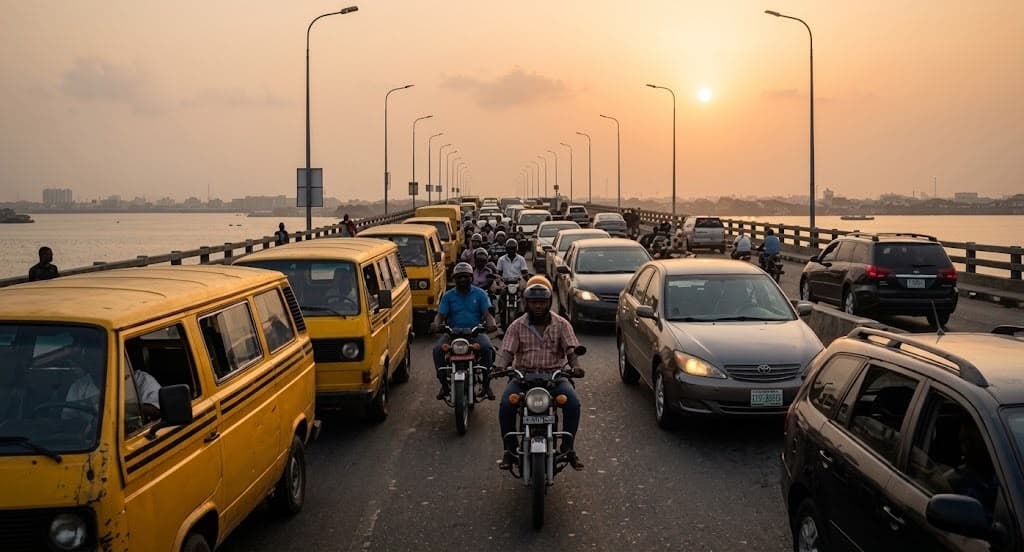
If you look at Egypt on a map, it seems almost improbable. Most of it is desert. And yet one of the world's oldest civilisations grew along a single river running through it, the Nile, which cuts from Sudan in the south to the Mediterranean in the north, spreading into a wide delta that turns otherwise arid land into some of the most densely inhabited territory on the African continent.
Cairo rises from that landscape as a city of more than 20 million people. Its streets carry commuters, students, traders, government workers and entrepreneurs through a metropolis that feels simultaneously ancient and urgently modern. There is traffic at three in the morning and strong, sweet tea every hour. Mosques and Coptic churches stand within walking distance of each other in neighbourhoods that have been continuously inhabited for a thousand years.
Most people outside Egypt think they know it. They know the pyramids, even if they cannot name the pharaoh who built them. They know the Nile, even if they think of it as a postcard rather than the reason 110 million people are alive and fed. They know the desert and the hieroglyphs and the golden mask of Tutankhamun rotating slowly behind glass in a museum they may never visit.
What most people do not know is Egypt in the present tense.
Egypt is the Arab world's most populous country and, depending on the year and the exchange rate, the second- or third-largest economy on the African continent. It is a Muslim-majority nation with one of the oldest Christian communities on earth. The Coptic Orthodox Church traces its founding to the Apostle Mark around 60 AD, and that community is still very much present. Egypt's identity is layered in ways that outsiders consistently misread as contradictions: Islamic and ancient Egyptian and Coptic and recognisably modern, all at once, in a country where none of these things cancels each other out.
Almost all of Egypt's 110 million people live within a short distance of the Nile or in the cities of the Delta, because roughly 94 per cent of the country's land is desert. Its borders with Sudan, Libya, Israel and Gaza place it at the intersection of some of the region's most consequential geopolitical pressures. Geography, identity and politics are not separate threads in Egypt. They are the same thread.
And then there is the Suez Canal.
Built between 1859 and 1869 and nationalised by Egypt in 1956 in one of the defining acts of postcolonial sovereignty the twentieth century produced, the Suez Canal is 193 kilometres of engineered water connecting the Mediterranean Sea to the Red Sea. It means that a container ship carrying electronics from Shanghai to Rotterdam does not have to sail around the southern tip of Africa, cutting roughly seven thousand kilometres from the journey. Oil tankers, grain carriers and bulk cargo vessels from dozens of countries pass through Egyptian waters every day of every year.
Roughly 12 to 15 per cent of global trade uses this canal annually. Egypt owns it.
That is who we are talking about before a single economic statistic enters the picture. A civilisation that predates the Roman Empire. A country of 110 million people, half of them under 30. A city of 20 million. A river that built everything. And a canal that the world cannot afford to ignore.
Egypt Tops the African Country Index 2026
Africa is not a single country. It is a continent with 54 sovereign states, 1.4 billion people and enough structural variety between its northern coast and its southern tip to make any blanket investment thesis about the continent almost immediately suspect.
Countries across Africa have built their strengths in very different ways. Morocco has developed a strong manufacturing and export relationship with Europe. South Africa has deep financial markets and a diversified industrial base. Kenya has positioned itself as an East African services and technology hub. Ethiopia has made infrastructure and industrial parks the centre of its growth model. Egypt's distinction is that its economic weight does not rest on any single advantage. Its geography, population, trade flows, tourism assets, infrastructure and international relationships all contribute to where it stands.
The question was whether all of those things could be measured together.
Over four months, I led the teams at Benign and Scribblegreen through exactly that work. We wanted to evaluate African markets beyond the usual shorthand of economic size. Not with GDP rankings alone, not with the narrative enthusiasm that often accompanies coverage of Africa's growth without asking what, specifically, is growing and whether it will hold, but with a framework that could examine all 54 member states through the same lens and produce conclusions rigorous enough to defend.
The result was the African Country Index 2026. We evaluated every African Union member state across five weighted pillars: Economic Strength, Economic Wellbeing and Stability, Export Performance, Global Reputation and International Connectivity, and Market Potential. We sourced 23 indicators from the IMF, the World Bank, UNCTAD, the Harvard Growth Lab, the UN, and other institutional data sources, and we spent considerable time validating them. We built a transparency framework that flagged where data was strong and where we had to work harder to find credible proxies. Then we ran six alternative weighting scenarios to test whether our conclusions held up under pressure.
Egypt came out first, with a composite score of 62.4 out of 100
Not Morocco, which leads the continent in export complexity and manufacturing depth. Not South Africa, which has the deepest financial markets and the most internationalised economy on the continent. Not Nigeria, which carries Africa's largest nominal GDP and its biggest population. Egypt sat at the top of the table and held that position in five of our six alternative scenarios.
Egypt did not win a single pillar. It performed consistently across all five, with no catastrophic scores anywhere in the table.
South Africa grows slowly. Nigeria's fiscal position is volatile. Morocco's market is smaller. Egypt carries its own serious problems -- we will get to those. But when the full picture is considered, Egypt is the country where the most dimensions of investability converge simultaneously.

Think of it as a pentathlon. The athlete who wins a pentathlon is rarely the world record holder in any one event. They win because they are competitive across all five disciplines and their weakest event does not destroy them. Egypt ran Africa's best pentathlon.
The Multiple Engines of the Egyptian Economy
To understand why Egypt ranked where it did, you first have to understand how the Egyptian economy actually works. The most important thing to know is that it does not run on one engine.
Most large African economies have a single primary driver. Nigeria runs on oil. Angola runs on oil. Algeria runs on hydrocarbons. South Africa runs on mining and financial services. When that engine underperforms, the whole country feels it within a quarter. Egypt is structurally different. It runs four engines simultaneously: the Suez Canal, tourism, remittances and energy. That combination is both its greatest strength and, as we will come to, the source of its sharpest vulnerabilities.
The Canal's economic significance is easy to understate. In the fiscal year 2022/23, it generated $9.4 billion in transit fees from roughly 20,000 vessel crossings. That revenue flows directly to the state and arrives as hard currency in regular, predictable streams that underpin Egypt's ability to service its debt and import the wheat it cannot grow domestically in sufficient quantities. Canal revenues represent about two per cent of GDP, a figure that understates their importance because of the structural effects that currency has once it arrives.
Tourism, the second engine, is more varied than most people realise. In 2025, Egypt received approximately 19 million international visitors, a 21 per cent year-on-year increase, generating around $16.7 billion in revenue. But these visitors were not from one market. Cultural tourists came to Cairo to visit the newly opened Grand Egyptian Museum in Giza, one of the largest archaeological museums ever built. Nile cruisers boarded in Luxor and floated south past the Karnak temple complex, the Valley of the Kings and the temples at Aswan. Red Sea resort tourists flew directly to Hurghada or Sharm El-Sheikh for the coral reefs and the sun, never going near a pharaoh. Three distinct tourism products, three different audiences. A security incident near Cairo does not empty the Red Sea coast. Regional tension in the Mediterranean does not close the Valley of the Kings. That geographic diversity within a single sector is a genuine stabiliser.
Remittances are the third engine and the most consistently underestimated. Egypt has more than 3.6 million nationals working abroad, concentrated in Saudi Arabia, the UAE, Kuwait, Qatar, Jordan, Italy and the United States. Total remittance inflows reached $29.4 billion in 2024, a 51.3 per cent increase over the prior year, according to the Central Bank of Egypt, rising to $36.5 billion by the end of FY 2024/25. At 11.4 per cent of GDP, Egypt's remittance intake is double the average for lower-middle-income countries. What makes this engine particularly valuable is its resilience: the Egyptian diaspora keeps sending money home through conflict, shipping disruptions and inflation crises. There is one important caveat. When Egypt maintained a distorted official exchange rate sitting far above the actual market rate, remittances began shifting into informal transfer channels because using the banking system meant accepting an artificial conversion. The pound floated in March 2024, eliminating that distortion, and formal flows rebounded immediately. The lesson is clear: this engine is reliable, but only when the policy environment deserves its trust.
The fourth engine is energy, and it carries the most complicated recent history. The 2015 discovery of the Zohr gas field by Italy's Eni, the largest natural gas find in the Mediterranean, with estimated reserves of 30 trillion cubic feet, briefly transformed Egypt from an LNG importer into a net gas exporter. By 2019, production had ramped to approximately 90 million cubic metres per day. Then the field matured faster than anticipated and investment slowed as Egypt accumulated roughly $6.4 billion in arrears to international oil companies. Output fell by more than half from the peak. Power cuts became routine. The recovery is now underway, with new drilling at Zohr, fresh offshore production from BP's Raven field, a $3 billion LNG supply agreement with Shell and TotalEnergies, and continued expansion in solar and wind generation. The engine is not back at full strength, but it is being rebuilt, and the direction is clear.
What all four engines share is that they generate foreign currency: the dollars, euros, and Gulf riyals that Egypt needs to service external debt, import food and fund investment. An economy earning hard currency from four structurally distinct sources is more resilient than one that depends on a single source. That basic architecture is part of what the ACI measured and part of why Egypt scored where it did.

But Four Engines Also Mean Four Points of Failure
The honest version of the same argument runs like this. The same breadth that makes Egypt structurally resilient also means that when external conditions deteriorate, multiple revenue streams can come under pressure simultaneously.
And between late 2023 and early 2024, they did. The Gaza conflict began in October 2023. Within weeks, Houthi forces in Yemen began attacking commercial shipping in the Red Sea. Shipping companies rerouted around Africa's Cape of Good Hope to avoid the risk. Suez Canal traffic fell sharply, with revenues declining approximately 40 per cent from 2022 highs. Coface, the French credit risk agency, estimated that Canal traffic was still running at roughly 70 per cent below 2022 peak levels as of 2025/26.
Tourism felt the spillover. European visitors who monitor regional security narratives pulled back from Red Sea bookings. The UNDP estimated that declines in combined tourism and Canal revenue across FY 2023/24 and 2024/25 cost Egypt approximately $9.9 billion in a medium-intensity scenario.
Remittances partially shifted to informal channels during the same period because exchange-rate distortions made official banking channels unattractive. And the energy sector was already constrained by the Zohr decline and the IOC arrears problem.
All four engines were under strain simultaneously, in an economy carrying $163 billion in external debt and an inflation rate that had climbed to 38 per cent by late 2023. Food inflation ran at 54.7 per cent in FY24. Bread, which Egyptians call aish, a word meaning "life," became expensive in the country of the Nile.

The World Bank estimates that poverty, measured against the lower-middle-income country line of $4.20 per day, rose by approximately five percentage points between 2022 and 2024. That is a statistic with a human weight. That decline on a population of 110 million was the perfect recipe for a crisis. Female youth unemployment stood at 33.8 per cent in 2025. Women's overall labour force participation sits at approximately 15 per cent, roughly one-third of the global developing-country average. These are not footnotes to the story of Egypt. They are chapters of it.
The ACI did not ignore any of this. Egypt's Wellbeing and Stability pillar score was competitive rather than commanding. The methodology presented the challenges in proportion rather than smoothing them over. An honest reading of Egypt's first-place ranking has to hold both things at once: the structural breadth that earns it the position, and the structural fragility that makes that position hard-won.
The Country That Needs the World
There is a particular kind of economy that can only function at full capacity when the world is fully engaged with it. Egypt is one of them. But the relationship runs in both directions: Egypt needs the world, and the world, it turns out, needs Egypt too.
Egypt needs the world to sail through its canal. It needs the world to fly into its airports, float down its river and spend at its beach hotels. It needs Gulf states to employ its workers and send money home. It needs international energy companies to drill in its Mediterranean waters. And at critical moments, it needs large injections of external capital to stabilise its finances when domestic and regional pressures converge.
The clearest recent example came in February 2024, when Egypt signed a $35 billion agreement with Abu Dhabi's sovereign wealth fund ADQ, granting development rights over 170 square kilometres of Mediterranean coastline at Ras El-Hekma for a planned integrated city. It was the largest single investment deal in Egypt's history. The inflow of hard currency gave Egypt the room to float the Egyptian pound in March 2024, finally dismantling a managed exchange rate that had been distorting markets and suppressing formal remittance flows for years. It also unlocked an expansion of Egypt's IMF programme from $3 billion to $8 billion.

Without that $35 billion, the sequence that followed, the IMF expansion, the reserve recovery to $67.5 billion, the fall in inflation from 38 per cent to 14.1 per cent, and the GDP growth rebound to a three-year high, would have been significantly harder to achieve on the same timeline.
This is the leverage of a country the world cannot afford to let fail. Egypt's strategic geography, population scale, control of the Canal and shared border with Gaza mean that every major power with interests in the region, the United States, the European Union, the Gulf states and China, has a direct stake in Egyptian stability. That is geopolitical weight translated into financial support. Egypt is not the first country to convert strategic necessity into capital inflows, and it will not be the last.
The dependency, however, is real and deserves honest accounting. The UAE alone accounted for 68.7 per cent of Egypt's FDI inflows in FY 2023/24. Saudi Arabia, Qatar and Kuwait have collectively pledged tens of billions in the same period. Egypt is the IMF's second-largest borrower in the world, after Argentina. If Gulf capital priorities shift, or if Egypt's political alignment with Gulf interests were to change, the external architecture underpinning the current reform cycle would look very different. That is not a reason to dismiss the investment case. It is a variable that belongs inside any serious model of it.
The Long Game: What Egypt Is Building
None of these pressures have stopped Egypt from building.
The New Administrative Capital, 45 kilometres east of Cairo, is the most visible signal of state ambition. A purpose-built government and business city designed to relieve a capital that has grown faster than its infrastructure can serve, it now houses relocated government ministries, a new Central Bank headquarters and Africa's largest stadium, which opened in March 2024 with a capacity of 93,940. The open question, which serious analysts continue to ask, is whether the NAC becomes a genuinely productive economic centre that businesses choose for commercial reasons, or whether it remains primarily an administrative relocation project. That question is still being answered. But the capacity to build it at all, in the middle of a macro stabilisation crisis, signals something real about institutional reach.
The Suez Canal Economic Zone is a more immediately tangible vehicle. Covering 461 square kilometres across two governorates, with six industrial zones and three ports, it has attracted $10.8 billion in green energy project commitments alongside manufacturing and logistics investment. For investors focused on the global energy transition, the SCZone's position within the canal corridor makes it one of the more strategically interesting special economic zones in Africa.
Egypt's renewable energy ambitions are among the most concrete on the continent. The Ras Ghareb wind farm on the Red Sea coast, Africa's largest at 500 megawatts, began operations in April 2025. The Benban solar park in Upper Egypt is among the world's largest solar complexes. The government targets 42 per cent renewable energy in the national mix by 2030, with the UAE's Masdar and Saudi Arabia's ACWA Power as active partners. The capital and the expertise are already in the room.
The 2024 to 2030 economic strategy sets targets that stretch well beyond the current trajectory: 6 to 8 per cent GDP growth in constant prices, 7 to 8 million new jobs, private sector contribution rising from 60 to 90 per cent of economic activity, and debt-to-GDP falling below 70 per cent. The gap between where Egypt is today and where those targets sit is significant. But direction matters, and the IMF programme creates accountability structures that at least partially enforce delivery.
GDP growth reached a three-year high of 5.3 per cent in the first half of FY 2025/26. Non-oil manufacturing expanded 14.5 per cent. The ICT sector grew at the same rate. Tourism was up 13.8 per cent. These are not projections. They are the most recent reported figures. Egypt is not simply trying to grow its economy. It is trying to build the economy it wants to have next.

So, Why Does Egypt Rank First?
Egypt ranked first in the African Country Index 2026, not because it is the richest country in Africa, the fastest-growing, the best-governed, or the most sophisticated exporter. It is none of those things. It is the most complete economy on the continent across the dimensions the ACI was built to measure.
On Economic Strength, its GDP ranks consistently among Africa's top three, its FDI position is the continent's strongest, and its foreign reserves have recovered to $67.5 billion. In terms of Global Reputation and Connectivity, the Canal gives Egypt a structural presence in global trade that no other African country can match. BRICS membership starting in 2024 adds a multilateral dimension, and bilateral investment treaties with over 100 countries provide a legal investment framework that covers more markets than any peer. On Market Potential, 110 million people, half under 30, with mobile penetration above 90 per cent and accelerating urbanisation, is a consumer demand story that is present rather than projected.
On Wellbeing and Stability, Egypt is honest about its position: competitive rather than commanding. The inflation peak, the debt burden, and the rise in poverty are registered in the scoring. Egypt did not win this pillar. It did not lose it either.
On Export Performance, the clearest structural gap, Egypt's export basket is volume-led rather than complexity-led. Petroleum, chemicals, textiles, and agricultural products. Its Economic Complexity Index score has improved, but still trails those of Morocco and South Africa. Egypt exports more by weight than by ingenuity. The index recognised that constraint and the pillar score reflects it.

When we ran the ACI rankings across six alternative weighting configurations, shifting pillar weights significantly to test whether Egypt's position was an artefact of our methodology, Egypt held first place in five of the six scenarios. The single scenario in which it lost the top position required substantially upweighting Export Performance while simultaneously downweighting Economic Strength. That is a theoretically valid configuration. It does not reflect how institutional investors or sovereign risk frameworks typically approach country evaluation.
A conclusion that survives five of six stress tests is not fragile. It is durable. And durability is the argument. Egypt's first place is not a snapshot that will look different next quarter. It is the product of structural features that do not shift on a news cycle: a canal the world depends on, a population of 110 million, a diplomatic network spanning dozens of frameworks, and a foreign currency architecture built on four distinct engines.
What Egypt Teaches Us About Reading Africa
There is a tendency, when assessing African economies, to reach for the most dramatic variable and anchor the story there. The fastest GDP growth rate. The biggest FDI headline. The most spectacular megaproject render. The most visible reform announcement.
Egypt resists this tendency, and that resistance is instructive.
Egypt's story in 2024 was not a growth story. It was a durability story: surviving three simultaneous shocks, Canal disruption, tourism pressure and an inflation crisis, while maintaining enough institutional capacity to execute a currency reform, close a $35 billion investment deal and begin a genuine macroeconomic stabilisation. In the context of a continent where economic momentum can turn on a single commodity price or a single election outcome, that kind of durability is underpriced.
What Egypt teaches anyone trying to read Africa seriously is that the most important question is not which country is growing fastest right now. It is which country has the most dimensions of investability converging at the same time. Size, geography, institutional depth, trade connectivity and market demand. When these things align in one place, the result is not dramatic. It is reliable.

There are 54 countries in the African Union. Some are growing faster than Egypt. Some have cleaner governance records. Some have more sophisticated export baskets. Some carry less debt. But none of them, at this moment, brings together the range of structural attributes that Egypt does.
That is the ACI argument. That is why 62.4 puts Egypt at the top of the index.
An investor looking at Africa in 2026 should not be asking whether Egypt is worth examining. They should be asking how much they have already missed by not looking sooner.

The African Country Index 2026 is an independent, 54-market research project developed by Ariyo Oluwaseun BATi and the team at Benign and Scribble Green, which scores African economies on economic strength, stability, trade performance, global reputation, and market potential. The published report draws on data from the IMF, the World Bank, the United Nations, UNCTAD, UN Tourism, and ITC trade sources, among others. It is a comparative screening tool, not a forecast of investment returns, and is not a substitute for country-, sector-, or transaction-level due diligence. The full report is available to download here: bit.ly/ACI2026Report.